 Building the Healthcare Brain
  Healthcare Brain · Clinical Reasoning · Live in production
 Clinical operations,
unified.
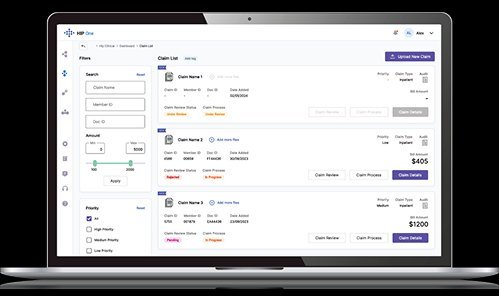
HIP One — Health Intelligence Platform unifies prior authorization, utilization management, medical review, payment integrity, and quality measurement on a single AI-native platform. The Reasoning Lobe of the Healthcare Brain by Genzeon Platforms. Deployable across every shape (sovereign, government cloud, commercial cloud, on-prem). Consumable as a full platform or as individual agents.
PA productivity gain in clinical review
Satisfaction across active deployments
Auto-denials. Every non-affirmation routes to a human reviewer.
HIP One Medical Necessity Agent is live on Microsoft Marketplace.
The clinical decision agent at the heart of HIP One, now buyable as a productized SKU on Microsoft Azure Marketplace for payer prior authorization. Same medical necessity reasoning live in CMS Medicare via WISeR — transactable through Microsoft Azure billing.
Recover 90% of your clinical capacity. From 70-minute reviews to 6 minutes.
From the WISeR clinical research: HIP One reduced complex clinical review from 70 minutes of human workflow to 6 minutes of platform-assisted synthesis. Same medical-necessity rigor. 90% capacity returned to the bedside.
HIP One — the Reasoning Lobe of the Healthcare Brain at Genzeon Platforms.
HIP One is the Reasoning Lobe of the Healthcare Brain — the lobe responsible for clinical synthesis, medical-necessity reasoning, and decision defensibility. The Healthcare Brain runs on Aether One™ — the Intelligent Foundation underneath every Genzeon Platforms deployment.
- Reasoning — HIP One · clinical synthesis & medical review
- Engagement — PES One · patient and member conversations
- Governance — CPS One · deterministic privacy & AI governance
A healthcare brain
that turns prior auth into a defensible decision.
HIP One is one platform with three stages of clinical reasoning, wrapped around the Aether One™ core. Requests come in from any system. Decisions go out with a citation chain. Every non-affirmation is reviewed by a licensed clinician — by design.
Decisions in minutes, not days
Turnaround compressed from days of phone tag to a determination in minutes — without sacrificing rigor.
Every non-affirmation routed to a licensed clinician. By design.
No model unilaterally denies care. Mandatory human review on every potential adverse decision.
Audit-ready evidence trail for every decision
Each determination carries a cryptographic chain of citations — query-ready for appeals, regulators, internal audit.
Tuned per payer, plan, and line of business
Same engine, different policy packs. Stand up Medicare Advantage and Commercial in parallel without forking code.
Authorization request → defensible decision
Compliance is structural, not bolted on.
Every mandate that touches authorization — CMS, HIPAA, MHPAEA, MAC policy — wired into the engine, not patched on top.
Cross-cutting infrastructure for every module.
The same core that determines a $40k specialty Rx and a $4 generic — secure inference, versioned knowledge, defensible evidence.
A platform, not a point tool.
Healthcare organizations have lived with tight deadlines, manual processes, and scattered tools. HIP One replaces that stack. Each module is an Aether One™ agent surface — configurable, auditable, and shipped weekly.
Prior Authorization (PA)
Automatically route prior authorization requests from providers or members to the right department, the right reviewer, and the right outcome — with auto-affirm where evidence is unambiguous and human review on every clinical non-affirmation.
FHIR PAS · X12 278/275 · NCPDP SCRIPT
Medical Review & Clinical Decision Support
HIP One summarizes health records and acts as a clinical decision support system, surfacing case-specific insights from unstructured clinical documentation. Built on the same NLP that powers our PA decisioning.
C-CDA · CCD · PDF/Fax · DICOM metadata
Medicare STAR Ratings & HEDIS
Insights into Plan D and Plan C measures, plus the operational levers that move them. Outcome-aligned payment metrics for ACCESS Model participants are surfaced through the same module.
CMS-0057-F · ACCESS Model · OAT engine
Utilization Management (UM)
Concurrent and retrospective utilization management on the same agent substrate as PA. Inpatient, post-acute, behavioral health, and elective procedure UM — with per-criterion citation chains drawn from NCD/LCD, payer policy, and InterQual/MCG equivalents.
FHIR · X12 278 · InterQual · MCG mapping
Complex Claims Review & Payment Integrity
Pre-pay and post-pay claim review automation. NCCI edits, coverage rule application, DRG validation, and clinical-coherence checks across surgical and high-cost claims — with the same audit-trail rigor as PA decisions.
X12 837 · NCCI · DRG mapping · clinical coherence
Risk Adjustment (HCC)
HCC capture and validation for Medicare Advantage. Chart review, suspect-condition identification, encounter-data validation, and prospective risk gap identification — same record digitization pipeline, different downstream pathway.
CMS-HCC v28 · RADV-ready · encounter validation
Medical Record Digitization
Extract structured data from medical records, automate data entry, reduce errors, and improve compliance. The data layer that feeds every other HIP One module.
8 ontologies · 2.2M record vector store
CliniGuard Vitals NER — published on Hugging Face.
Structured extraction from clinical notes is a building block underneath every HIP One workflow — medical review, record digitization, risk adjustment, the rest. CliniGuard Vitals NER is the open-weight version of that primitive we publish externally: 15 vital-sign and measurement categories across nursing notes, ED triage, and progress notes. Bio_ClinicalBERT base, ~110M parameters, Apache-2.0 license. Inspect it, evaluate it, integrate it.
Three integrated experiences. One end-to-end platform.
HIP One connects providers, service-operations teams, and clinical reviewers in a single end-to-end system. Each role gets the surface they need; every action lives in the same audit trail.
The provider-facing PA submission hub.
A secure, branded portal where providers submit standard prior authorizations, track real-time status, manage facility settings, and access decision letters — all in one place.
- Dashboard · drafts, in-review, recent decisions
- New PA submission · guided submission wizard
- Clinical details · diagnoses, codes, attachments
- PA status tracking · full lifecycle visibility
- Facility management · addresses, users, allowed domains
- Case management · ADR submissions, peer-to-peer
Other channels: fax, mail, direct integration.
PA intake, routing, and processing.
Service-operations teams receive, validate, and route inbound prior authorization requests to the right clinical queue — with real-time queue management and quality oversight.
- Intake dashboard · status, priority, workload
- Patient intake form · structured data capture
- PA routing & task flow · rule-based assignment
- Queue management · SLA-aware load balancing
- Quality & SLA metrics · live processing dashboards
- Throughput visibility · team and individual
Medical review and clinical decision.
Clinical reviewers assess submissions against medical-necessity criteria, issue formal decisions, and trigger compliant letter generation — with a full audit trail at every step.
- Medical review dashboard · SLA, priority, workload
- PA review — clinical details · full case context
- Clinical review workflow · structured decision flow
- Decision interface · affirmation, partial, non-affirm, dismissal
- Auto-triggered letters · provider and beneficiary
- Full audit trail · per-decision evidence chain
From provider submission to closed decision.
How a standard prior authorization moves through HIP One — one platform, one audit trail, five clear stages.
Submit PA
Provider submits via the portal — patient info, diagnoses, procedure codes, supporting clinical documents.
Intake & route
Service-operations team validates the submission and routes to the correct clinical reviewer based on PA type and payer.
Medical review
Clinical reviewer assesses medical necessity against criteria and issues a formal decision: affirmed, partial, non-affirmed, or dismissed.
Generate letters
Decision letters are automatically generated for the provider and beneficiary, and stored against the PA record.
Receive decision
Provider views the decision status and accesses letters directly on the portal dashboard. PA is closed.
Auto-deny is architecturally prohibited. Every clinical non-affirmation routes to a licensed clinician with a pre-built evidence package.
HIP One Summarization Agents turn dense CCDA records into clinical answers in seconds.
A generative-AI summarization agent inside HIP One. Extracts patient details, medication insights, and a navigable medical timeline from CCDA / C-CDA documents. Live on Microsoft Azure Marketplace and deployable standalone or as part of the platform.
- 01AI-Driven SummarizationConcise summaries from complex CCDA files
- 02Patient Data ExtractionDemographics, conditions, allergies, problem list
- 03Medication InsightsActive meds, dosing, prescriber, refills
- 04Medical TimelineChronological view of encounters and events
- 05Interactive ViewerSection-by-section navigation of source CCDA
Runs in customer's Azure environment. Full performance, scalability, and security.
Decision support, not decision-making.
Every clinical non-affirmation routes through Agent 871 (Non-Affirm Research) to a human reviewer. By architecture, not by policy.
| Capability | What it does |
|---|---|
| AI-powered decision support | For clinical nurses and medical directors. Surfaces evidence with provenance from the source document. Never surfaces a conclusion without showing its work. |
| Custom workflows | Tailored to payer or provider operating models — case routing, escalation paths, SLA tracking against CMS-mandated timeframes. |
| Seamless integrations | Epic, Cerner/Oracle Health, Meditech, Allscripts, eClinicalWorks, NextGen on the EHR side; Facets, QNXT, HealthRules, Amisys, Diamond on the payer side. |
| Clinical NLP | Extracts diagnoses, procedures, medications, lab values, and imaging findings from unstructured records. Trained on real clinical documentation, not generic web text. |
| FHIR-compliant APIs | CMS-0057-F day-one ready. CRD, DTR, and PAS in production. PA-RX adds NCPDP SCRIPT dual-channel for CMS-0062-P. |
| Scalable architecture | Adjusts to case volumes without resource strain. Sovereign-deployable for government health programs. |
Live in CMS Medicare with Novitas in MAC JL.
HIP One is the WISeR Participant for the New Jersey market under the CMS Innovation Center Wasteful and Inappropriate Service Reduction (WISeR) Model. Production go-live was January 1, 2026 — on the date CMS published, with no extended pilot. Operating in partnership with Novitas Solutions in MAC JL (Jurisdiction L) under federal SLA standards.
CMS WISeR Model
A six-year (2026–2031) CMS Innovation Center program testing whether AI-assisted prior authorization can reduce inappropriate Medicare FFS spending without restricting access to medically necessary care.
Novitas Solutions · MAC JL
Medicare Administrative Contractor for Jurisdiction L — Delaware, District of Columbia, Maryland, New Jersey, and Pennsylvania — processing Part A and Part B claims for ~13M Medicare beneficiaries.
Q1 2026 production
12,609 PA cases processed · 100% CMS three-day TAT compliance · <1 day turnaround for 90% of standard cases · sub-3-min median latency · 42% productivity gain in clinical review.
What is HIP One? Common questions answered.
What is HIP One and who is it for?
HIP One — the Health Intelligence Platform — is the Reasoning Lobe of the Healthcare Brain. It unifies prior authorization, utilization management, medical review, Medicare STAR Ratings and HEDIS, complex claims review, payment integrity, and risk adjustment on a single AI-native platform. Built for health plans, Medicare Administrative Contractors, integrated delivery networks, health systems, TPAs, and specialty management organizations. Live in CMS Medicare under the WISeR Innovation Model since January 1, 2026, in partnership with Novitas Solutions in MAC JL (New Jersey).
What modules does HIP One include?
Six primary modules covering the administrative-decision lifecycle: (1) Prior Authorization, (2) Utilization Management, (3) Medical Review and Clinical Decision Support, (4) Medicare STAR Ratings and HEDIS, (5) Complex Claims Review and Payment Integrity, (6) Risk Adjustment (HCC). Plus Medical Record Digitization as a cross-cutting input layer that turns scanned, faxed, and CCDA records into structured clinical data. All modules run on the same Aether One agent substrate and share the same audit ledger and per-criterion citation chains.
How is HIP One different from other PA automation tools?
Five architectural differences. Multi-agent consensus on every clinical determination, not single-model output. Atomic criteria evaluation — each NCD/LCD criterion evaluated independently, with its own citation chain (PA2 patent architecture). CMS production validation under WISeR — the first commercial-AI-assisted prior authorization model the federal government has run. Citation by architecture — 100% per-criterion citation chain on every determination. No auto-denials by architecture — every non-affirmation routes through Agent 871 to a human clinical reviewer.
Is HIP One production-deployed?
Yes. HIP One is the WISeR Participant for the New Jersey market under the CMS Innovation Center Wasteful and Inappropriate Service Reduction Model, in partnership with Novitas Solutions in MAC JL since January 1, 2026. Q1 2026: 12,609 Medicare Fee-for-Service PA cases processed at 100% CMS three-day TAT compliance, sub-3-minute median latency, decision turnaround under one day for 90% of standard cases. 42% productivity gain in clinical review measured in production.
What integrations does HIP One support?
FHIR R4 with Da Vinci CRD/DTR/PAS. CMS-0057-F compliant in production — Patient Access API, Provider Access API, Payer-to-Payer API, Prior Authorization API. X12 EDI 270/271, 278, 837. NCPDP SCRIPT for pharmacy ePA via Surescripts. HL7 v2 for legacy EHR integration. C-CDA, CCD, PDF, fax, DICOM metadata for medical record digitization. Marketplace-distributable agents on Microsoft Marketplace today; AWS, GCP, Salesforce in onboarding. Direct integrations with Epic via FHIR R4 (Epic Showroom) and ambient encounter integration via Microsoft Dragon Copilot.
Four steps to live deployment.
A predictable engagement path. No "scope a six-month POC" runway. From first conversation to production, with clear gates at each step.
Schedule a live demo
Walk through the platform with the team that built it. 45-minute working session against your real use case.
Review integration requirements
Map the platform to your existing systems — EHR, payer admin, telephony, identity, data warehouse. Document gaps.
Pilot with your data
Stand up a scoped pilot in your environment. Real data, narrow surface area, measurable outcomes from day one.
Deploy & go live
Production rollout with full audit posture, rule-pack governance, and the support model your team needs.
Key team members.
Architecture and delivery leadership for the Health Intelligence Platform — from agent design through live customer deployment.


Walk through HIP One with the team that built it.
45 minutes. Live, NCD-traceable rule packs running against published clinical guidelines. Your specific use case — whether that's payer UM consolidation, provider PA submission, or government Medicare program participation.
Five HIP One agents, available individually.
Some buyers replace an incumbent stack with the full HIP One platform. Others have one workflow stuck and want to fix that one workflow first. Each HIP One agent is available as a standalone SKU on Microsoft Marketplace — deploys in days, not quarters.
Eligibility
Real-time payer eligibility lookup with structured response. Drops into existing intake.
Pre-Check
Pre-submission medical-necessity check against payer-specific criteria. Surfaces missing documentation.
Duplicate Request
Catches duplicate PA submissions before they hit the payer queue.
Intake
Multi-channel PA intake (portal, fax, esMD) with normalization and routing.
Auto Approval
Affirms cases where evidence and criteria align unambiguously. Adverse cases route to clinicians.
All five agents inherit from HIP One’s per-criterion citation chains and clinician-in-the-loop architecture — same brain, single workflow.
How a federal innovation model met production reality in 90 days.
A long-form report on the first 90 days of the CMS WISeR Model in New Jersey. 12,609 PA cases. 100% three-day TAT. Sub-1-day turnaround for 90% of standard cases by April 2026. The companion Healthcare Brain — Prior Authorization whitepaper covers the architecture HIP One uses underneath.
Evaluating HIP One for your operating model? Talk to the team →
Two technical whitepapers.
Two technical whitepapers extending what you read on this page. The first is the architectural argument behind the Healthcare Brain — HIP One is the Reasoning Lobe. The second is the payer playbook for the CMS-0057-F + CMS-0062-P medical PA mandate — the operational framework HIP One was built against.
Inside the Healthcare Brain.
The architectural deep-dive. Triple-Tier Agentic Architecture, six substrate principles, governance invariants, patent foundation. ~5,800 words.
Read the whitepaper WHITEPAPER · COMPLIANCEMedical PA Compliance Engineering.
CMS-0057-F and CMS-0062-P implementation playbook for payers. FHIR PA APIs, decision timeframes, public reporting, no-auto-deny. ~5,400 words.
Read the whitepaperHow HIP One compares in the 2026 AI PA vendor landscape.
We published a direct comparison of six payer-side AI prior authorization vendors — Cohere Health, Humata Health, Optum, Availity, Microsoft Foundry PA Accelerator, and HIP One — across agentic clinical reasoning, citation architecture, and CMS-0057-F compliance, written from inside a live CMS WISeR deployment.
Read the 2026 AI PA vendor landscape →